
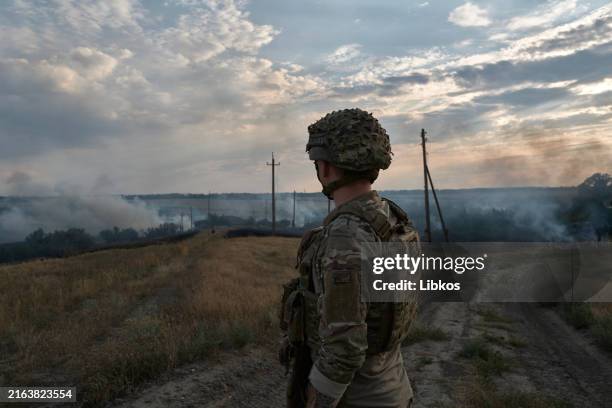
On the night of 24 February 2022, Vladimir Putin appeared on Russian state television to give an address. We now know that this was the start of the deadliest and longest conflict on the European continent since the second World War. While difficult to verify, the estimate of total casualties sits around 1.8 million.
Russia’s full-scale invasion of Ukraine is ongoing, but has already reshaped geopolitics in Europe, and around the world. Today, we explore pressing questions that remain as the fighting rages on: Where do the battle lines sit? Why have diplomatic efforts failed? What is the reality on the ground for Ukrainian civilians? And where do we go from here?

Battle Lines and Ongoing Offensives
This section will cover ongoing Russian and Ukrainian efforts in 4 provinces: Luhansk, Donetsk, Zaporizhia and Kherson. Russia has made limited incursions into the provinces of Kharkiv, Sumy and Dnipropetrovsk but has failed to sustain offensives. Even though other provinces remain firmly in the hands of Ukraine, drone and missile strikes are increasingly common in every pocket of the country.
Luhansk
In July of 2022, Ukraine announced that troops withdrew from the city of Lysychansk, ending their last holdout in the eastern part of the Luhansk province.
Since then, Russia has maintained relatively stable control of the region. While Ukraine still denounces trading land for peace as capitulation, it seems unlikely they would be able to keep Luhansk if a diplomatic deal was reached.
Donetsk
The situation in Donetsk has drawn the most coverage in recent months, largely due to Ukraine’s strategic “fortress belt”. The fortress belt is a string of four major cities and many smaller towns on the western flank of Donetsk. From North to South, the four cities are Slovyansk, Kramatorsk, Druzhkivka and Kostyantynivka.
Since Russia’s invasion of Crimea in 2014, where they also seized parts of the Donbas, (geographical term referring to Luhansk and Donetsk) Ukraine has exerted tremendous amounts of effort to ensure the fortress belt would be difficult to conquer for any advancing Russian units. And to this point, they have been extremely successful.
Terrain in this area is marked by hillsides and woodlands, making a large advance difficult for Russia. Open fields also leave troops vulnerable to drones, a type of warfare that Ukraine is becoming increasingly competent in. The strategic position of the fortress belt, as well as Donetsk’s deposits of rare earth metals such as Lithium and Titanium means it could be existential for Ukraine.
If Russia were to consolidate control over Donetsk, the road to Kyiv would become much more realistic. For now, the taking of the fortress belt by force seems nearly impossible. Russia is losing an approximate 1,500 personnel daily, and taking the rest of Donetsk would likely require exponentially higher losses. The Kremlin’s recent actions suggest they know this, and they seem to be keen on seizing Donetsk through a ceasefire deal.
Zaporizhia
Zaporizhia province is located on Ukraine’s Southeast and is cradled by the Dnipro River and the Sea of Azov. An industrial powerhouse, and home to the Zaporizhia Nuclear Power Plant (under Russian control since 2022), the region has seen heavy fighting since the start of the war. In late 2025, Oleksandr Syrskyi, Ukraine’s top commander, said the situation in Zaporizhia had “significantly worsened” after Russia seized control of three towns.
While the province’s capital city (also called Zaporizhia) has remained under Ukrainian control, estimates from the Institute for the Study of War indicate Russia controls about three-fourths of the province.
Kherson
Kherson lays to the Southwest of Zaporizhia, and is the only province that is accessible through the Crimean Peninsula, which was annexed by Russia in 2014. Russia took control of the city Kherson in the early days of the war.
Despite its liberation by Ukraine in November of 2o22, Kherson has perhaps seen heavier fighting than any other city. Drones and missiles constantly bombard the city. Once home to over 250,000 people, most have either left or live their lives largely underground. While Ukraine has held control of the city since it’s liberation, Russia controls about 70% of the province.
Recent Updates
On 1 February 2026, Elon Musk announced he had blocked unauthorized Russian access to Space X’s Starlink satellite internet. The decision seems to have caused confusion among Russian drone operators and allowed for Ukrainian advances. The situation is currently unfolding and will be something to watch moving forward.

Trump 2.0 and the Dollarization of Diplomacy
Donald Trump, now somewhat infamously, promised he would have the war over in 24 hours of taking office. The war was not ended in the early stages of Trump’s second term, but he did have a blow up with President Zelenskyy in the oval office, further complicating the relationship.
It is worth noting that Joe Biden, Anthony Blinken, and the rest of the previous administration substantively failed to engage Russia and Ukraine in any meaningful way during their term. However, they offered constant and strong support to Ukraine, in both rhetoric and arms, something the Trump administration has not done.
Negotiations with Russia under Trump 2.0 have largely started and stopped with one man: Steve Witkoff. Witkoff is a real-estate mogul and a golfing buddy of Donald Trump but has no prior diplomatic experience whatsoever. Appointed to be Trump’s special envoy to the Middle East, Witkoff has instead become the de-facto envoy to the Kremlin.
Witkoff has met with Putin multiple times (including once where he forgot his own translator) and helped arrange the August 2025 summit in Alaska. The Alaska summit should have been notable, but produced nothing of substance, and allowed Putin to stand side-by-side with the American president, without any sort of Ukrainian representative present.
Bilateral Bidding
Witkoff’s meetings with top Russian diplomats have almost entirely omitted Europe and largely have omitted Ukraine itself. In November of 2025, after a meeting with Russian envoy Kirill Dmitriev, Witkoff announced a 28-point peace plan deal.
The peace plan deal reads less like a compromise and more like a Russian wish list. Stipulations of the plan included Ukraine’s cessation of the entire Donbas (even the fortress belt), denouncing Ukraine’s ascension to NATO, limiting the size and scope of Ukraine’s military, amnesty for war crimes of Russia’s leaders, and much more.
The plan was dead on arrival, but the nature of its conception highlights the Trump administration’s willingness to capitulate to Russian demands in order to end the war. Diplomatic efforts have continued in recent months without any significant breakthroughs, suggesting no ceasefire deal is imminent.

Reality on the Ground
Ukrainian civilians have endured unimaginable hardships since the start of Russia’s invasion, but this most recent winter has likely been the most difficult. Russia’s strategy in late 2025 seemed to shift to the deliberate targeting of Ukraine’s energy grid. So much so that Donald Trump took notice and personally asked Putin for an energy ceasefire.
In late January 2026, the U.S. helped negotiate a deal that would pause attacks on both country’s energy infrastructure. Details were vague, but it seemed both sides had agreed on at least the concept of an “energy truce”. All hope for a sustained ceasefire came crashing down along with Russian missiles less than a week later, as the destruction of a Kharkiv power plant left large parts of the city without power.
Sub-Zero Blackouts
Temperatures in February in Ukraine have dropped to as low as -26° C (-15° F). In Kyiv more than 1,000 apartment buildings are left without power, and the situation is worse in many Eastern cities. Blackouts have left millions of Ukrainians in the cold but are far from the only problem facing the country’s population.
Russian strikes have disrupted both food and water supplies, forcing some families to go up to 90 days with only a week’s worth of flour and basic medicine. Putin hopes he can bomb Ukrainian civilians into submission, but the will of the country has proven to be strong time and time again.
4 Years In: Is There an End in Sight?
When Russian troops started their march towards Kyiv, there was not a western leader or pundit that truly believed Ukraine would be able to hold Russia off, at least not to the extent they have. President Zelenskyy deserves a lot of credit, for his initial decision to not flee Kyiv, and his resolve since.
With that being said, Ukraine is in a difficult position. A $100 million dollar corruption scandal, perpetrated by Zelenskyy’s inner circle, threatened to bring Ukraine’s government down from the inside. While Zelenskyy seems to have survived, the situation on the ground is quickly becoming untenable.
Beyond the blackouts and food shortages, Ukraine has constant manpower problems. Russia’s ability to absorb higher losses is a significant factor in the fighting. The country’s economy also faces massive contractions, with a depleted and aging workforce. Perhaps most consequentially, the inconsistency of support from the United States, makes long-term military planning impossible.
The European Union, whose fate is most closely impacted by what happens in Ukraine, has been strong in their support in some areas, but fallen short in others. As over €280 billion of Russian assets sit frozen in the continent, the European Council failed to mobilize €90 billion of the funds for an aid package to Ukraine. Hungary, allies with Russia, promised to veto the package, and other European capitals expressed concerns with the plan.
Ukraine’s ability to not just defend, but hit Russian targets in Russia, including oil depots, naval and aerial capabilities has been impressive, but it will take more to sustain a fifth year of fighting. Stronger support from European capitals is paramount while Trump’s unpredictability looms large.
Pressure on Putin?
It should not be lost that Vladimir Putin said the war would be over in three days, and that it wasn’t a war at all. Four years later, and the man that has had an iron grip on Russia since 2000, is at least starting to show cracks.
Russia’s losses are high, and may be sustainable in the short to medium term, but they are not unlimited. After a brief stint where North Korean soldiers fought along side the Russians, there has been evidence of recruitment of soldiers from Africa and Asia, in an attempt to shore up the front lines.
Russia now spends half of their federal budget on the war. While this allows for an excess of tanks, shells and drones, the future of the country’s economy is in jeopardy. Western sanctions have squeezed crude oil revenue, and failure to re-integrate into the world economy could see Russia in an economic free fall after the war.
Russia has serious economic and political concerns, but there is no sign that Vladimir Putin will become serious about a peace deal, at least not until Russia is on the verge of total victory, or total defeat.


Leave a Reply