
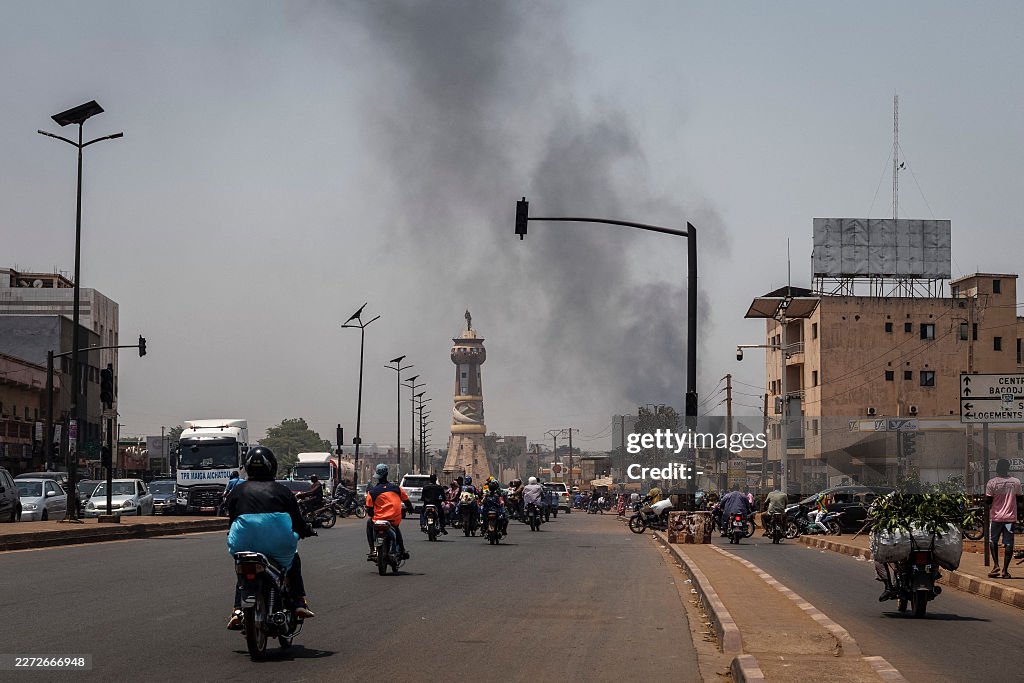
A wave of coordinated attacks unfolded across the African Nation of Mali on 25 April, 2026, further plunging the country’s security situation into uncertainty. The Al-Qaeda linked Islamist militia, Jama’at Nusrat al-Islam wal-Muslimin (JNIM) claimed responsibility for the attacks. JNIM, formed in 2017, currently has a foothold in Sahelian countries such as Mali, Burkina Faso and Niger, with an escalating presence in Benin.
While casualty numbers are murky, JNIM killed Mali’s defense minister in a suicide bombing, highlighting their capability to strike targets, not just cause chaos. The scale and effectiveness of the attack is ringing alarm bells in the region, but there is something else that threatens Mali, and the Sahel: JNIM did not act alone.
Separatist Ambitions
The Azawad Liberation Front (FLA) claimed joint responsibility for the attacks in late April. The FLA is the latest organization of the Tuareg nationalist movement, which dates all the way back to Malian independence in the 1960s. The Tuareg, who are a Berber ethnic group, clash with Mali’s government over the Northern part of the country, of which they declare to be their own independent state of Azawad.
A coordinated insurgency between Islamist and rebel factions is particularly concerning for the ruling Junta in Mali, who came to power in a 2020 coup. Since then, the military has consolidated power and expelled French forces in favor of Russian mercenaries. The Russian “Africa Corps”, formerly known as the “Wagner Group”, has proved ineffective in repelling attacks from JNIM. Numerous atrocities committed against the Tuareg rebels at the hands of the Africa Corps has further pushed the group to align with Islamist militias.
History Often Rhymes
Allegiance between Islamist militias and ethnic minority groups is rare, but not entirely unprecedented. In 2012, the FLA’s predecessor organization declared independence for the state of Azawad in Northern Mali. In coordination with Al-Qaeda in the Islamic Maghreb (AQIM), the Tuareg rebels were able to push Mali’s military out of the territory. AQIM is regarded as the precursor to JNIM.
As quickly as the partnership between AQIM and the Tuaregs came together, it began to disintegrate. AQIM and other Islamist groups insisted on implementation of strict Shariah law in Azawad, while the Tuareg rebels wanted a secular, tolerant state. The disagreement proved to be fatal for the alliance, and the Islamist groups, who were better armed and better trained, turned on the Tuareg rebels. Shortly after, the Islamist insurgents pushed the rebels out of key Northern cities, including Timbuktu, Gao, and Kidal, effectively ending the Tuareg’s claims for an independent state.
International organizations, fearing that Mali could become a hotbed for terrorism, jumped in to stabilize the situation. The Economic Community of West African States (ECOWAS) brokered a series of ceasefires between the government and the rebels, while an UN peacekeeping mission deployed to quell the Islamist groups. Peaceful elections in 2013, and the signing of the Algiers Accords in 2015, gave outside observers hope for a stable Mali, but it did not last. The Algiers Accords (2015) were a series of peace agreements between the Tuareg rebels and the Malian government, but were torn apart by Mali’s junta in 2024, leading to the formation of the FLA and a revitalized Tuareg fervor for independence.
Extremism, Politics and Statecraft
AQIM failed to establish themselves in 2o12 because they lacked political sophistication, and could not maintain a secular ally. Sahelian Islamist groups have long used violence, propaganda, shock and awe to achieve territorial and political goals, but JNIM could prove to be different, and more adept than their predecessors. Their ability to engage local ethnic communities through governance, rather than pure coercion, is reminiscent of Hezbollah in Lebanon and Hayat Tahrir al-Sham (HTS) in Syria.
While JNIM does not yet have the level of political organization of Hezbollah, or even HTS, there are clear parallels. Hezbollah has spent decades building a parallel state inside of Lebanon, and has garnered political legitimacy by providing social services, establishing political representation and entering parliament. At the same time, Hezbollah has maintained a militant wing.
HTS, who broke off from Al-Qaeda in 2016, represents a more recent comparison to JNIM. The split gave HTS a chance to rebrand, promoting “transitional” and “inclusive” governance, rather than a Jihadist holy war, which has long been the mission of groups like Al-Qaeda and the Islamic State. After the fall of the Assad Regime in late 2024, HTS has remained in power in Syria. Ahmed al-Sharaa, the groups leader, has shown a pragmatic governing posture, engaging western leaders, and promoting unity among a diverse Syrian population, at least in rhetoric.
A Region in Crisis
Lebanon and Syria are examples of Islamist militia groups who adapted governance techniques to entrench themselves within the state, and Mali could be headed in a similar direction. JNIM’s coordinated attacks with the FLA represent a legitimate threat to the government’s grip on power, which is already weak outside of the capital, Bamako.
The failed alliance of Islamist insurgents and Tuareg rebels in 2012 informs the present situation, but that doesn’t mean history will repeat itself. The fact that the Tuareg understand better than anyone that an alliance with JNIM is dangerous, and are willing partners anyway, is perhaps the most telling detail of all.
2 responses to “Mali: Security and Sovereignty in the Sahel”
“Branding” is critical to image building for any group. Terrorist or political party. Interesting that they are learning lessons from Hezbollah brand also that this plays out during a time when Iran has mastered the art of image making (see Lego videos).
💯💯💯