
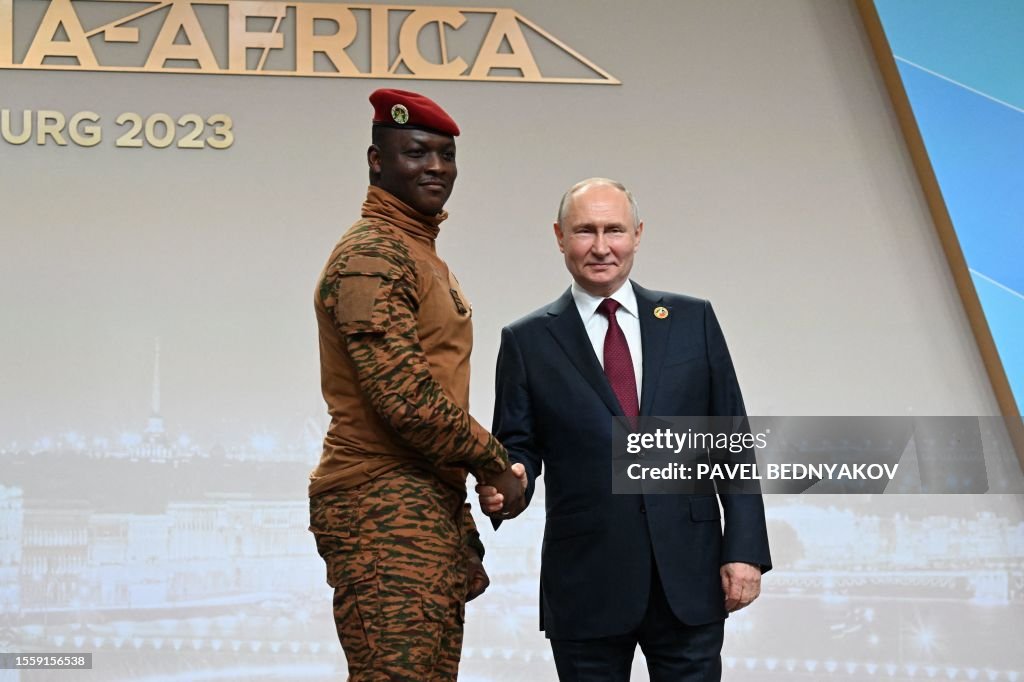
Burkina Faso, a little known country sitting in the heart of Africa’s Sahel region, is making headlines for its new leader’s youth, charisma and ambition. Ibrahim Traoré, a 37 year-old military captain, assumed the role of interim president following a coup d’etat in 2022. In just a few short years, Traoré has played a big role in Burkina Faso’s development and taken strides to end dependence on France, hoping to break from the country’s colonial past. The rapid industrialization and decolonization efforts have made him a hero among many of the 24 million Burkinabés. At the same time, some international experts fear Traoré’s policies signal a crackdown on civil liberties and a consolidation of state power. Traoré’s meteoric rise has not been without problems. As Islamist militia groups occupy parts of the country, he weighs a strategic yet dangerous partnership with Russia.
A History of Colonization
In 1896, during the scramble for Africa, the kingdoms that make up present day Burkina Faso became a French protectorate. Despite stiff resistance from the indigenous Mossi people, the French military, who already had a foothold in the region, were able to gain control. In 1919, Burkina Faso integrated into French West Africa. As colonial empires became weaker in the aftermath of World War II, the voices calling for independence grew louder. France introduced a series of reforms starting in 1947, allowing for a limited form of self-governance. These reforms did little to satisfy Burkina Faso’s (then Upper Volta) hunger for independence, which it finally achieved on 5 August, 1960.
Post-Colonial Involvement
The immediate history of independent Burkina Faso is defined by a period of political instability and violence, not dissimilar to other former French colonies. A series of coups saw the rapid succession of governments, culminating with the assassination of Thomas Sankara in 1987, who was popular for his contributions to Burkina Faso’s development and staunch pan-Africanism. France’s military never truly left after independence, maintaining a presence to prevent Islamist insurgencies and perpetuate colonial-era resource transfers.
Traoré’s Vision
Born into a military family on 14 March, 1988, Ibrahim Traoré followed in the footsteps of his father, becoming a soldier. Rising quickly through the ranks at the academy, he began training in anti-aircraft weaponry after graduating. In 2014, Traoré joined a UN peacekeeping mission in Mali. It was there that he would get his first experience fighting Islamist insurgent groups, a perennial threat to the region’s security. Afterwards, Traoré returned to Burkina Faso to help quell insurgencies in his homeland, promoted to captain in 2020 for his efforts.
A Year of Coups
As insurgent attacks killed over 2,000 people and forced more than 1.5 million from their homes between 2015-2022, according to UN reports, public opinion on then president Roch Kaboré began to sour. The country’s military was underfunded, under-equipped and untrained to fight the growing insurgent groups, many with links to Al-Qaeda and the Islamic State.
The discontent culminated in the January 2022 coup d’etat, executed by the country’s military leadership, including Traoré. Coup leader Lt. Col. Paul-Henri Sandaogo Damiba assumed the role of president. However, Damiba’s rule only lasted until September of the same year. Deciding that he was no better suited to stabilize the situation against Islamist insurgents than his predecessors, the same military leadership ousted Damiba in favor of Traoré.
A Man of The People
Burkinabés are no strangers to military coups, and promises of a safe and stable society are met with understandable skepticism. Traoré decided to take a few symbolic measures to gain the trust of his people. Firstly, he declined the salary hike that would come with being president, declaring “I will not take a single cent more than I did when I served as a soldier.” In addition, Traoré decided to slash the salary of ministers and parliamentarians by 30 percent, promising the funds would result in a 50 percent pay increase for workers around Burkina Faso.
Burkina Faso’s Development and Decoupling
Gold has long been Burkina Faso’s most important industry, accounting for 78.8 percent of the country’s exports in 2023. Despite this, revenue from gold mining operations has evaded Burkinabés, and found its way to foreign companies. In June, Traoré announced the expulsion of five foreign mining companies, and the subsequent nationalization of their operations. Citing French investors linked to the companies, he sees gold mining as a way to reclaim the country’s industry, improving life for everyday citizens.
Traoré’s plan to accelerate Burkina Faso’s development includes the rapid expansion of infrastructure and transportation. “Air Burkina” was once a thriving regional airline, but was grounded in 2005 due to financial difficulties. Traoré announced a $50 million USD dollar investment into the airline, leading to flights resuming in October of 2024.
In addition to air travel, Burkina Faso is undergoing rapid modernization in a myriad of sectors. The stated goal of the projects is to expand the country’s economic opportunities and enhance its security apparatus. With an investment equal to $352 million USD, the initiative has an ambitious target of paving 3,000-5,000 km of road annually. The government is also embarking on a range of digital expansion projects. Hoping to bring economic growth by expanding network coverage, and promoting mobile payments, the minister of digital transition announced partnerships with Orange and Moov, the countries two largest network providers.
An Existential Problem: Insurgencies
While Traoré’s efforts to modernize and de-colonize the country have made him popular, the success of his presidency, and the entire country, rests on his ability to quell Islamist insurgent groups. Jama’at Nusrat ul-Islam wa al-Muslimin (JNIM) is one of the fastest growing militant groups in the world, and the largest in the Sahel region. The group formed in 2017 when five separate Islamist groups, including the Sahara branch of Al-Qaeda, merged. Imposing Sharia Law in their controlled territory, the group started in Mali, but now has a major foothold in Burkina Faso.
Shortly after coming into power, Traoré introduced a large-scale recruitment drive for the military junta. The campaign hopes to encourage civilians to volunteer for front line battalions, who regularly clash with insurgents. According to Armed Conflict Location & Event Data, over 90,000 people signed up for the Civilian Defense Force Volunteers (VPD). While Traoré’s ability to garner national fervor is remarkable, the reality for soldiers is bleak. Volunteers are given only fourteen days of training before being sent to the front lines to fight against Jihadist insurgents, who are well-trained, well-armed and ruthless. Critics of Traoré say the volunteer program is simply a tool for him to conscript dissidents and political opponents to fight and die against insurgents.
Tracking Insurgent Activity
The map below shows areas of activity of two Islamist groups in Burkina Faso: JNIM and the Islamic State. Provinces highlighted in red have significant reported activity from JNIM, while provinces highlighted in red and orange have significant reported activity from JNIM and the Islamic State. *This map is based off of reports from Jules Duhamel, a geospatial analysis expert.

Traoré and the military have maintained control over the capital region surrounding Ouagadougou, but JNIM effectively exercises authority over large swaths of the country. The Islamic State’s influence in the Sahel has wained for some years now, as they are largely contained to the country’s northeastern border regions.
Russia’s Growing Influence
With the French military expelled from the country, Traoré has tapped Russia’s “Africa Corps” for his personal security. The Africa Corps is a repackaging of the former Wagner group, a private militia that integrated into the Russian military in 2023, after a failed mutiny against Vladimir Putin and Moscow. Consisting of the same forces, the Africa Corps largely operates in the Middle East and North Africa. The group provides security in exchange for natural resources such as gold, diamonds and rare earth metals. Experts point to a host of war crimes committed by the Wagner group, including the indiscriminate killing of civilians, rape and torture, arguing that this activity swells recruitment by Jihadist groups.
After a 2023 Africa-Russia summit, Putin promised 100 paramilitary fighters to protect Traoré and train Burkina Faso’s own troops. The number is not nearly enough to have a significant impact in the fight against JNIM, but may be enough to shield Traoré from a coup. According to reports, Traoré has survived 19 assassination attempts in his two years as president, including a failed 2023 coup from his own intelligence and security services.
Conclusion
Captain Ibrahim Traoré’s ambitious agenda to excel Burkina Faso’s development is undeniably impressive, and has produced tangible results in a short period of time. The World Bank Group expects a near 5 percent growth of Burkina Faso’s GDP in 2025. Traoré’s gold nationalization and infrastructure projects are no small part of this.
The young president has made serious progress in doing away with western post-colonial control of Burkina Faso. At the same time, however, he has moved closer to the Kremlin. Such a partnership promises less strings attached in terms of financial deals, but the human rights record of the Africa Corps means chaos and conflict are unlikely to disappear.
While Traoré’s charisma and early economic success have made him popular, his continued struggles to quell JNIM insurgencies threaten to topple his presidency from the inside. Burkina Faso’s situation highlights the daily struggle of millions who live in a constant state of violence and fear, but it also represents a broader regional power struggle.
As Sahelian countries free themselves from the influence of former colonial powers, Russia and China have emerged as potential partners for both economic and military cooperation. A debate is ongoing on whether these deals, centered around natural resources, are beneficial for Sahelian countries. Proponents of partnerships with Russia and China argue that these countries’ reluctance to interfere in domestic politics marks an improvement over previous agreements with Western states and institutions. Critics, however, contend that such deals merely represent a new form of colonial-era coercion and may ultimately prove disastrous for countries like Burkina Faso.
3 responses to “Burkina Faso: Security and Sovereignty in the Sahel”
Really cool article , I kinda had no clue about this and I think it’s a really fair perspective that is not only from a western viewpoint but is also critical China and Russia .
This is a great article and highlights the criticality of the vacuum left by the US retreat from international diplomacy.
Grandson Jack this is a very informative article and one can see you put a lot of research into it 👍 you are destined to be a great writer